

Environmental Paternalism: A Lineage
In this essay, I mean to question the ways in which those of us from the dominant epistemic culture seek to help, let alone solve, the supposed problems of others. This is an ethical question prior to being a theoretical one, and as such I will ground it in my personal experience before wandering through history and theory and back again. Coming from a family of missionaries, ministers, and medical doctors, I am quite familiar with the desire to help. It is not this desire as such that I am so concerned with—but rather the places we do so, the paradigms out of which we speak, and the forces compelling us of which we may be unaware. My life has been spent on a particular frontier—a world I use deliberately with all its freight—between disparate conceptions of nature and humanity, between modernist and indigenous worldviews, between Africa and the West. It is this troubled frontier I will explore.
I. The Image

There is an image I have from the years I spent in northern Kenya in my twenties that encapsulates the contradictions of my experience on that frontier. The photograph (above) was taken by an Italian photographer who had climbed atop a Land Cruiser parked at a school a few kilometers from Ol Moran village in Laikipia. In the image, I am standing in front of a group of about three dozen men—Pokot pastoralists with their idiomatic blankets slung over jackets or round the waist—with my arm gesturing, pen in hand, making some significant point. The men are sitting on wooden school chairs, their backs mostly to the camera, some huddled under the scant shade of a spindly acacia. It is dry and the sun beats down from directly overhead. A friend of mine stands next to me, squinting in the glare, translating my words into the Pokot language.
In the photo, I am in the midst of explaining how climate change, though principally the result of Western industrialized societies, is coming for us all. At the time, I was working for a private nature conservancy in the region. We had experienced a spasm of violent conflict across the landscape and were attempting to resuscitate a community grazing plan that would allow local pastoralists to register and legally graze their cattle within the reserve—rather than do so by the gun. It was my job to persuade them—and so I was explaining how these changes beyond their control and through no fault of their own were degrading pastoralist landscapes and disrupting livelihoods. How these increased pressures on land and resources were contributing to the incessant violence. How, most importantly, collaborating with the conservancy through a structured grazing program was their best path towards sustainable pasture and peace.
I have no way of knowing what Rianomuto, my interpreter, said to them. Nor do I know how convinced the men were by my master narrative of responsibility; I remember mostly a silent, skeptical gaze as they awaited more official details of the deal. I drove away from that meeting with the strange out-of-balance feeling one gets after offering up your best argument, your whole earnest worldview, and getting back a perfunctory nod. It is like the wind sucking away your breath. The grazing deal came together—to this day it is a reasonable success—but I am not sure my exhortation had anything to do with it.
Seeing this moment as a photograph has since clarified some of my feelings. In the image, I look both authoritative and distinctly out-of-place. I am young—twenty-six at the time—and the sole white person in the frame. Most days in that job I felt like I was doing something important, even righteous. But something about that day revealed a latent ethical asymmetry: the incoherence of my offering advice—nay, solutions—to these men who have been keeping livestock since they were children, just like their great-grandfathers. I was arguing from narratives that I'd inherited more than interrogated, superficial readings of the landscape that disguised the deeper forces at work and protected my own position as a do-gooder.
For the rest of this essay, I will be exploring the history and ideas that put me in that position. In the process, I have found that what I've come to call an ideology of environmental paternalism runs unbroken through a long history of Western involvement in Africa. Although the political and economic context has evolved continuously from the early colonial period through independence and into contemporary capitalist "development," a tendency to characterize local African communities as unproductive, their livelihoods as environmentally unsound, and their cultures as inherently violent has persisted, taking new and insidious shape with each new context while preserving certain basic coercive and extractive power relations.
II. "Development"
The origins of these narratives are many centuries old, reappearing in altered guises as political and moral conditions shift. The rhetoric at the height of the "Scramble for Africa" in the late nineteenth century reveals them in a moment of naked brutality. I will quote a particular and characteristic speech at some length in order to see the whole ideology at once.

The British colonialist Harry H. Johnston epitomized the European mentality during that period. As explorer and administrator, he devoted his life to a vision of Africa thoroughly under European control. In a speech before the Liverpool Chamber of Commerce in 1891, entitled "The Development of Tropical Africa under British Auspices," [2] he makes very clear that Africa is seen, first and foremost, as a bountiful natural resource for the taking:
"We must explore and exploit the undeveloped riches of these lands, so that we may discover and utilize the many oils, drugs, perfumes, food-stuffs, dyes, fibres, gums, woods, timbers, and other products of African vegetation; so that we may maintain and control our supply of African ivory and yet prevent the extermination of the African elephant; so that we may mine the gold and silver and antimony and copper and diamonds of the African rocks and river valleys, fish up the pearls from its oyster beds, and utilize its scarcely touched deposits of coal and mineral oil; so that we may cover its grassy uplands and well-watered plateaux with teeming herds of cattle, sheep, horses, and asses, and its arid sandy plains with ostriches and camels; and lastly, so that we may make servants, soldiers, cooks, clerks, carpenters, seamen, craftsmen, herdsmen, agriculturists, fellow-workers, fellow-helpers, friends and equals from among the Arab, Negroid, and Negro races." [3]
The African person comes last in this lustful paean to the riches of the continent. It is only some few decades since the slave trade was legally abolished, but it is clear that the African still serves in this vision of "development" first as labor and only some day, perhaps, as "friends and equals." To justify this obvious exploitation, Johnston delivers all of the most deleterious, persistent, and hypocritical tropes. As he claimed:
"We must teach the poor savages, of whom we have become the guardians, the blessings of peace, the advantages and profits which accrue from hard work, and in course of time and of many generations raise them up to a condition of perfect civilization…They must be persuaded and, if necessary, compelled to abandon their incessant intertribal wars, which keep half of Africa in a fluctuating state of devastation; they must be weaned from slave-making and slave-dealing, from cannibalism, from bush-fires which destroy such valuable forest, from head-hunting, witch-burning, and human sacrifices." [4]
Thus the African is described as unproductive, warlike, and environmentally destructive all at once. It is implied that force will be used to "compel" improvements. But perhaps the most dangerous and critical for the resilience of these narratives were his subtle, slippery equivocations:
"For a long time our country would seem to have been impelled…by blind instincts of commercial expansion…rather than by any definite and deliberate plan of extending her direct rule over Tropical Africa…Above all, let us avoid irritating the more astute of the black or yellow natives by the assumption in our preachings to them of a lofty tone of impeccability where our own past actions are concerned…We are really not so many centuries ahead of the Negroes that we can afford to be arrogant." [5]
Here he suggests that the future of British governance in Africa is in fact a prudent response to the "blind instincts" of the early mad scramble. Efficient extraction could only be facilitated through deliberate administration by the imperial state. There is also the careful pretense of humility, a moral self-vindication that will become a distinctive theme. Europe has not been blameless in either its own house or its rapacious advance around the globe. Yet this is all the more cause, Johnston says, "For those of us who believe in the duty of helping our poor relations…to extend a helping hand." [6]

It is as uncomfortable to cite such a virulent speech as it is to read it, the more so immediately after providing a personal anecdote—the purpose is not to conflate the two moments, for obviously and evidently much has changed. Yet there are certain parallels important for our exploration of environmental paternalism. Most fundamentally, there is the epistemic posture: we know how to improve your situation. There is a subtle but disingenuous self-incrimination: we have not been perfect—but now we know better, and we can show you. There are the narratives in the background (or foreground) that justify our superiority. Finally, there are ways in which this attitude overtly or implicitly serves the status quo of political control and economic extraction. This is the structure of environmental paternalism at its rawest. Still, Johnston was preaching to the choir. In that chamber there was no resistance, political or ecological, to reveal the deep incoherence of these ideas. To understand how this ideology has shapeshifted from Johnston's to the present day, we must go to the colonial frontier—which was first and foremost about agriculture.
III. The White Highlands
The history of colonial agriculture demonstrates how the ideology of environmental paternalism responds when its internal contradictions result in inevitable, unintended consequences. Johnston and his contemporaries proposed that the African environment was prolific to the point of overwhelming the indolent locals, invoking a moral duty of the European to make productive the land and the labor. Thus the "fertile, cultivable soil" [7] of Sub-Saharan Africa became a site of both dispossession and deliberate assimilation.
As European settlers spread across newly founded colonies, innumerable African communities were forcibly relocated to make room for such projects as the "White Highlands" of Laikipia, Kenya. Settlers established the ranches and farms that Johnston had envisioned across vast areas, relying on locals as labor who were instructed in European farming techniques, increasingly those of "high-modernist" agriculture. This meant large-scale, industrializing, monocrop plantations of such cash crops as wheat, coffee, and sisal. The instruction from "agricultural specialists" and "experts" demeaned indigenous systems of agriculture as inefficient and primitive and increasingly pushed African farmers to adopt "modern" techniques.

This process served colonial economic interests through export production and political interests by making the land and its peoples more "legible" and hence easier to control. I lean here on the work of scholar James C. Scott, who has shown that many of the methods of imperial economic expansion ultimately sacrificed sustainability in the interest of "simplification." The modern "scientific" approach to agriculture carved up dynamic land use systems in order to document, market, and govern. Yet "it is the systematic cyclopean short-sightedness of high-modernist agriculture," writes Scott, "that courts certain forms of failure." [8]
Within only a few decades the vision of Africa as profligate abundance to be developed had transformed into one of rampant devastation to be controlled. By the mid-twentieth century, widespread erosion and soil degradation had become a primary concern of the colonial administration—and there was a ready-made narrative to account for it. Writing about colonial Kenya, scholar David Anderson states, "By 1938, both the Colonial Office in London and the administrators in East Africa were committed to a policy of direct intervention in the husbandry practices of African farmers and herders, in any circumstance where it was feared that these practices might be detrimental to the long-term productivity of the land…[whereas] in fact, many parts of the White Highlands were already experiencing soil exhaustion and declining fertility as a result of overproduction through cereal monoculture." [9]
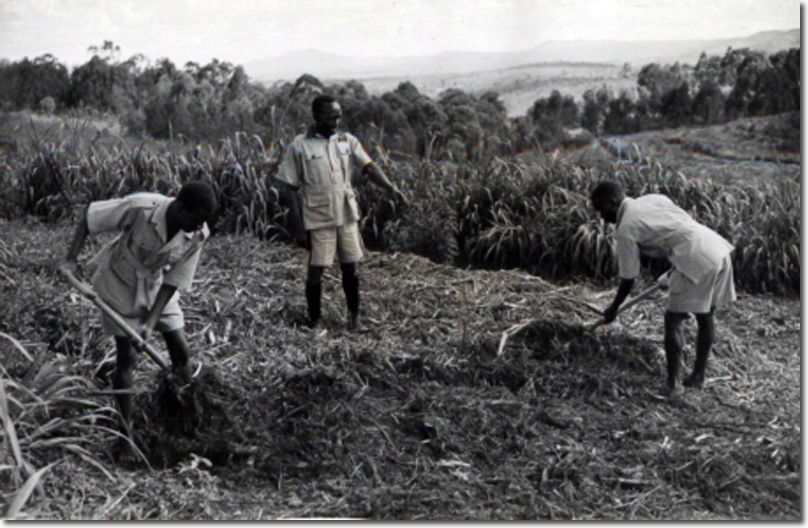
The problem was thus misdiagnosed and the intervention misdirected. Anderson adds that "in reality land alienation, the demarcation of fixed reserve boundaries in the 1920s, and demographic pressure, had done much more to destroy soil fertility." [10] A narrative that had been deployed to justify initial settlement and dispossession was now reconfigured to explain the resulting ecological damage, warranting further control.
As the damage of industrial agriculture became clear, colonialists shunted blame onto Africans and maintained their epistemic and moral posture of superiority. In a vivid instance of moral projection, settlers claimed that "the spread of 'selfish individualism' at the expense of the communal solidarities of pre-colonial Africa, it was suggested, had undermined the balance between Africans and their land." [11]

Anderson observes that "the Kenya authorities chose to ignore these politically embarrassing explanations for the growing ecological crisis in the reserves since they called into question the future of the European 'reserve' in the Highlands." [12] Ultimately, the hypocrisy of this land alienation in Kenya was the principal battle cry of the Mau Mau revolutionaries, routinely vilified as backwards and savage and brutally repressed—violence begetting violence in another self-justifying feedback loop.
These narratives prove so resilient because they weave together political, economic, social, racial, and scientific ideas into a hegemonic epistemic worldview—meaning one could repudiate one aspect of it, such as the racism, while reproducing another. James Scott helpfully shows how "the imperial pretensions" of agricultural science, "its inability to recognize or incorporate knowledge created outside its paradigms," led to its abuses and failures. [13] In colonial agriculture as in arguably all other arms of imperialism, political and economic control shaped the project.
IV. The "Cotton Expert"

I have begun with discussion of colonial agriculture because we now turn to the experience of one particular "specialist" to examine the ways he interacts with, contests, and perpetuates this paradigm. In 1904, my maternal great-grandfather spent a year in the Gambia as a "cotton expert" for the British Cotton Growing Association. I only learned of this chapter fairly recently when my parents, who worked in Kenya as missionaries for several decades, returned to the United States and moved into my late grandmother's house. She had kept a box of his records from that time. [14] As I investigated this idea of environmental paternalism, prompted by my own time as a young man working in rural Africa, I realized that looking to his experience might help clarify how these attitudes manifest within an individual's experience and transform over time. Reading through his journals was an intimate and troubling experience, revealing and confirming more than I could have hoped.

George Lee Echols was recruited by the Association to assess the viability of growing cotton as a cash crop in the Gambia protectorate, then a Crown Colony of Britain. His professional journals from January to December of 1904 are a mixture of daily records, ledgers and accounts, drafts of official reports, diagrams of agricultural test plots and other technical minutiae. But it is the anecdotal asides that are the most revealing.
In his first few weeks, his daily entries are lengthy and comprehensive. On January 12, he is introduced to a local chief he calls Sambiola, of a village he records as "Chacunda." Echols "had no interpreter," he writes, "but fortunately, on the previous day, I had picked up about twenty native phrases, and with these…I succeeded in making my way nicely." He spends some days with Sambiola, who he claims was "struck with surprise at the two beautiful stalks of cotton" he had brought with him as demonstrations. Yet he also records that the chief immediately tells him that "his town was not good for cotton."
Echols is quick to judge the local techniques, noting Sambiola's "mistakes of leaving his cotton too thick in the 'hill,'" and visiting "two patches of cotton that were rather discouraging, not on account of the cotton, but because of the crude ideas of the native farmer." "Cotton thus planted," he claims, "could not be a success even in the best parts of the American Cotton Belt." At other times he is more receptive and curious, noting the chief's "good ideas" regarding tool usage and seasonal planting restrictions. In any case, he seems enthusiastic about his mission: "This is a critical period in the development of cotton culture with the people at Chacunda," he writes.
He is soon sent out to develop an "experimental farm" at a location called "Wellinghara" that he chooses because the "natives here are kind and agreeable…industrious farmers…[and] anxious for Experimental Farm to be located here for their own instruction." Although he claims that "the field is not near Village" and "thus the land near the native home is left for his own cultivation," he elsewhere admits a disquieting fact: "This field was headman Kundi's, the headman at Wellinghara, individual groundnut farm, and I think that he was very much surprised when he realized that I was taking practically the best of his cleared land."
Echols is told repeatedly that the "natives at Wellinghara are not satisfied, and many have signified their intention of moving away. This dissatisfaction seems to be caused by scarcity of land and a fear of extra work for the government." His curiosity wears thin as he encounters resistance from the laborers on the farm, who are "digging day and night." He claims a man "reported himself sick, though apparently well. Another took off two hours for resting…not satisfactory." By April 14, only a few months in, his tone has changed: "Most of the day spent with laborers, disgusted with their slow and crude manner of work."

His journal entries become shorter and more terse as the year goes on. He travels the countryside village to village persuading the "head men" to give cotton a try. These scenes felt like almost mirror images of my own experiences, a century apart. "Had long talk with head chief of district," he writes on December 2. "Explained methods of planting, cultivation, and gathering…He spoke very encouragingly, saying that he knows the district to be well-suited for cotton, and expressed himself very much pleased to know that there would be an export market for cotton, and the price paid would be satisfactory." The word "export" appeared to be filled in afterwards, with a remedial arrow.
I have no way of knowing how genuine this chief's response was—every chief he mentions speaking to has a strangely similar enthusiasm, an almost evasive agreeability that I have personally encountered many times. What else was the chief going to say, really? And what was George Echols going to write down? That he felt that "strange out-of-balance feeling one gets after offering your best argument, your whole earnest worldview, and getting back a perfunctory nod?" George Lee Echols turned twenty-nine during his year in the Gambia, the age I am as I write this.
I was not surprised to find these attitudes embedded in my great-grandfather's journals—he was a white, southern American young man working for a colonial cotton company. What I was struck by was how closely his records mapped onto the whole structure of environmental paternalism, and the way in which incipient human connection seemed to be subsumed by the momentum of these forces. His early curiosity and enthusiasm soon faded into a more exasperated, supervisory and pedantic posture. The repeated glimpses of local ambivalence and refusal are at odds with his too-perfect accounts of amiable chiefs.
Unfamiliarity with indigenous agricultural systems led him to rely on ready-made narratives of "crude" local techniques; when local villagers fled the coerced labor or resisted in various ways, he read it as a distaste for hard work; when he claims someone's land for his experiment, their protest is written off as "surprise;" and all the while he claims the locals are "anxious" for the advantages of the export economy, indeed "very much pleased."

"The agricultural specialists' claims to be neutral technicians with no institutional stake in the outcome," writes James Scott, "can hardly be accepted at face value." [15] Those tasked with implementing a vision of "development," confounded by the dynamic complexity of African indigenous land use systems, fall back upon these narratives. Their investment in the narratives means that when unintended consequences occur, they misdiagnose the problem and project it back onto the local rural communities. This sort of self-protecting superiority complex is essential to the maintenance of control, because any genuine acknowledgement of reciprocity—I think of George Echols' very first interactions with Sambiola—threaten the whole premise of the extractive system. As Scott argues, "The unspoken logic behind most of the state projects of agricultural modernization was one of consolidating the power of central institutions and diminishing the autonomy of cultivators and their communities…To the degree that specialists had to negotiate with farmers as political equals would the basic premise behind the officials' institutional status and power be undermined." [16]
From within that epistemic paradigm it can be very difficult to recognize how our vision can become warped. I do not claim that my great-grandfather was wholly disingenuous—but rather that the ethical and epistemic asymmetries of the frontier overwhelmed him and he slid all too easily back into the posture and rhetoric of environmental paternalism.
V. Rangelands
I cannot condemn my great-grandfather for these attitudes without to some extent implicating myself. His journals were troubling to read because my own experience, working on the borderlands between agricultural and pastoral Kenya in the twenty-first century, reflects some of the same dynamics. Like him, I had the role of a young, earnest Westerner working on the frontier to in some sense "improve" local techniques. Like him, I am operating with a narrative that purports to have solutions to a problem—in my case, that of the degradation of pastoral rangelands within the "climate crisis."

There is much historical ground to traverse between us, of course, and I will not attempt to do so comprehensively in this essay so much as to illustrate these dynamics in a new historical context. As Amitav Ghosh puts it: "The ideologies and practices of settler colonialism have been actively promoted, in their neoliberal guise, by the world's most powerful countries, and have been almost universally adopted by national and global elites." [17] A particular epistemic paradigm birthed in colonialism has evolved alongside global economic and political transformations without fundamentally changing its function.
The scholar Garrett Hardin became something of a Harry Johnston for this neoliberal era. In his now-infamous "Tragedy of the Commons," he took pastoralists as his illustration, claiming that "each man is locked into a system that compels him to increase his herd without limit—in a world that is limited. Ruin is the destination toward which all men rush." [18] With familiar irony, he more accurately described the "blind instincts of commercial expansion" [19] of modern capitalism than the habits of most pastoralists. Yet he used this spectre of degradation to invoke "mutual coercion" in governance of resources, becoming the ideological godfather of "a large and often problematic literature on range degradation and overgrazing." [20] As pastoral territories—often sites of valuable mineral deposits and fossil fuels—became new targets for extraction, the tried-and-true ideology of environmental paternalism found a new target.

In much the same way as early colonial agriculture, this rhetoric paved the way for increased territorialization and control, which led to inevitable ecological degradation, which led to scapegoating of local communities. As Kenyan scholar Egeru Anthony writes, "the real tragedy in the pastoral environments is not that of overpopulation but…development projects …triggering competition and disenfranchisement of grazing lands by governments." [21] An ecological review from a multidisciplinary team led by Maarten Wynants perfectly describes this cycle as they diagnose the complex causes of soil degradation in rangeland environments so often attributed to pastoral ignorance and incompetence:
"A direct consequence of the centralised agricultural intensification in the diverse and dynamic East African agro-pastoral systems was that areas under years of monocropping regimes and intense grazing were experiencing soil exhaustion, declining fertility and severe erosion. Indigenous farmers and pastoralists were shunted and confined to marginal areas where they struggled to adapt to the unfamiliar and constricted ecological space, often leading to land degradation and famine…Perversely, these effects of exclusion were in turn used to argue and implement further exclusion and stricter regulations…The thread that links the history of land management from pre-colonial times to current conditions can be summarised as the blindness of the modern state, both colonial and post-independence, to the complexities of the locally co-adapted agro-pastoral systems. Key to this is the top-down introduction of interventionist agricultural policies within western notions of economic growth and societal development." [22]
This thread leads us finally to the epistemic paradigm that I was operating within while I worked in Laikipia: the world of modern conservation, which has taken up many of these "notions" of development. In unsettling ways, some of the same logics are still at play. Modern conservation science generates data on degradation, which justifies the further intervention of "experts," which demands land appropriations for global conservation frameworks, which generates further division and conflict with communities, which is used to justify securitization. All the while in the background, this increase in control and legibility lends itself to further extraction. "Green" capitalism is now commodifying everything from carbon to genetic sequences to the traditional ecological knowledge of Indigenous peoples. [23] The frontier merely moves—and as always, violence hovers around the edges.
In this sense, even the narrative of the "climate crisis," which I myself invoked, can be a slippery slope toward asserting epistemic hegemony and coercing compliance with a particular vision of the world and the future. As Sara de Wit writes, "This climate change focus similarly bears the risk of engendering blind spots, for it increasingly serves as an all-embracing explanatory framework." [24] In her study of pastoralist attitudes toward climate discourse in Tanzania she explains that "in the case of the agropastoral Maasai, who have had a longstanding problematic relationship with the government of Tanzania, climate change discourses are indeed embraced by the latter as the ultimate scapegoat to explain away the deplorable socio-economic conditions [and] to obscure ongoing practices of land alienation…in the name of conservation." [25]
This dynamic is eerily familiar to me. What I failed to recognize in my own presentation to the Pokot was how even my sympathetic framing—positioning them as blameless victims of Western-caused climate change—could erase their own knowledge, their generations of adaptive strategies, their agency as actors rather than objects of crisis. The climate narrative, even deployed with good intentions, can become another way of asserting that we understand their situation better than they do.

Fortunately, de Wit also recounts a court hearing in which a Maasai man "redirected the hearing about climate change into a heated debate about the political processes that have shaped the socio-cultural and environmental landscape of which the Maasai pastoralists form a part…revealing a long-term struggle about how the ancestral lands…were to be managed and by whom." [26] Thus, as in my own and my great-grandfather's contexts, this hegemony is being actively resisted, and we unwitting agents of it have the opportunity to listen, reflect, and consider what we might be perpetuating—to consider what lineage we might be standing in.
VI. The Frontier

Throughout this essay I have struggled to know what to call this phenomenon. Given how it changes form without essentially changing function, is it "a dominant epistemic culture," a paradigm, an ideology, or an ethical posture? Is it the logic of colonialism that pervades everything we've discussed, or is it capitalism? Is the "thread" the toxic brew of centralized planning with totalitarian tendencies, as Scott might argue? Or is it a more basic human disposition to dominate? As we've discussed, the manner in which these elements co-constitute one other, braid into one another, makes it very difficult to discern what, if anything, is the fundamental error. But I am inclined to quote the Indigenous philosopher Tyson Yunkaporta, who writes, "It's not a conspiracy. It's just power doing what power does." [27]
I find it interesting how often the idea of "blindness" appears in this discussion, or what Scott calls "cyclopean short-sightedness." [28] A cyclops can see from only one perspective, can tolerate only one perspective. This partial sight, characteristic of power, is the belief "that only someone outside and above the display can fully appreciate it as a totality." [29] Thus the paradigm protects itself through projection: as in the image that the Italian took from atop the Land Cruiser, this "totality" obscures the image-maker. We pretend we are on the outside—watching it, fixing it.

If we are inside, participating, in reciprocal relationship—it is harder to think we can know everything. Paternalism rests most fundamentally upon this sense of being the good guy. Johnston needed to believe in his civilizing mission. My great-grandfather needed to believe he was bringing agricultural improvement. I needed to believe I was helping with the climate crisis. We must ask, then: when we "extend a helping hand," [30] who are we really helping?
The frontier, therefore, can be two things: a site of violence where one paradigm overtakes another, or a site where the contradictions become visible, where the human encounters that destabilize the paradigm can occur. My hope is that learning to recognize these forces at work might slowly inoculate us against them, but this will require more than analysis. I have not focused here on the alternative—on the many examples of how cultures and individuals maintain an epistemic posture that does not demand legibility and superiority. The first step is taking a good long look in the mirror, turning the camera around. Once we recognize that we are not and never will be in control, it might be possible to help after all.
References
All images either public domain or my own.
[2] Harry H. Johnston, "The Development of Tropical Africa under British Auspices," Fortnightly Review 48, no. 287 (1890): 684-706.
[3] Ibid., 686.
[4] Ibid., 686, 705.
[5] Ibid., 684, 706.
[6] Ibid., 706.
[7] Johnston, "The Development of Tropical Africa Under British Auspices," 694.
[8] James C. Scott, Seeing like a State: How Certain Schemes to Improve the Human Condition Have Failed (New Haven: Yale University Press, 1998), 264.
[9] David Anderson, "Depression, Dust Bowl, Demography, and Drought: The Colonial State and Soil Conservation in East Africa during the 1930s," African Affairs 83, no. 332 (1984): 322, 324.
[10] David Anderson and David Throup, "Africans and Agricultural Production in Colonial Kenya: The Myth of the War as a Watershed," Journal of African History 26, no. 4 (1985): 343.
[11] Ibid.
[12] Ibid.
[13] Scott, Seeing like a State, 264.
[14] All citations in this section are from these Echols family archives.
[15] Scott, Seeing like a State, 286.
[16] Scott, Seeing like a State, 286.
[17] Amitav Ghosh, The Nutmeg's Curse: Parables for a Planet in Crisis (Chicago: University of Chicago Press, 2021), 167.
[18] Garrett Hardin, "The Tragedy of the Commons," Science 162, no. 3859 (1968): 1244.
[19] See H.H. Johnston quoted above, page 5.
[20] Roger M. Blench, 'You Can't Go Home Again': Pastoralism in the New Millennium, Animal Health and Production Series, No. 150 (Rome: Food and Agriculture Organization of the United Nations, 2001), 42.
[21] Anthony Egeru, "Tragedy of the Commons and Pastoral Livelihood" (unpublished manuscript, Department of Land Resources Management and Agricultural Technology, University of Nairobi, n.d.), 2.
[22] Maarten Wynants et al., "Drivers of Increased Soil Erosion in East Africa's Agro-Pastoral Systems: Changing Interactions between the Social, Economic and Natural Domains," Regional Environmental Change 19, no. 7 (2019): 1913, 1917.
[23] This trajectory is demonstrated in Santiago Castro-Gómez, "The Missing Chapter of Empire: Postmodern Reorganization of Coloniality and Post-Fordist Capitalism," Cultural Studies 21, no. 2-3 (2007): 428-48.
[24] Sara de Wit, "To See or Not to See: On the 'Absence' of Climate Change (Discourse) in Maasailand, Northern Tanzania," in Environmental Change and African Societies, ed. Ingo Haltermann and Julia Tischler (Leiden: Brill, 2020), 30.
[25] Ibid., 33.
[26] de Wit's PhD thesis is referenced in Mike Hulme, Climate Change, Key Ideas in Geography (London: Routledge, 2022), 128, 131.
[27] Tyson Yunkaporta, Sand Talk: How Indigenous Thinking Can Save the World (Melbourne: Text Publishing Company, 2019), 65.
[28] Scott, Seeing like a State, 264.
[29] Scott, Seeing like a State, 254.
[30] See H.H. Johnston, quoted above on page 6.
Bibliography
Anderson, David. "Depression, Dust Bowl, Demography, and Drought: The Colonial State and Soil Conservation in East Africa during the 1930s." African Affairs 83, no. 332 (1984): 321-43. https://doi.org/10.1093/oxfordjournals.afraf.a097622.
Anderson, David, and David Throup. "Africans and Agricultural Production in Colonial Kenya: The Myth of the War as a Watershed." Journal of African History 26, no. 4 (1985): 327-45. https://doi.org/10.1017/S0021853700028772.
Blench, Roger M. 'You Can't Go Home Again': Pastoralism in the New Millennium. Animal Health and Production Series, No. 150. Rome: Food and Agriculture Organization of the United Nations, 2001.
Castro-Gómez, Santiago. "The Missing Chapter of Empire: Postmodern Reorganization of Coloniality and Post-Fordist Capitalism." Cultural Studies 21, no. 2-3 (2007): 428-48. https://doi.org/10.1080/09502380601162639.
Dalby, Simon. "Climate Change and Environmental Conflicts." In Routledge Handbook of Environmental Conflict and Peacebuilding, edited by Joakim Öjendal and Ashok Swain, 42-53. London: Routledge, 2018.
de Wit, Sara. "To See or Not to See: On the 'Absence' of Climate Change (Discourse) in Maasailand, Northern Tanzania." In Environmental Change and African Societies, edited by Ingo Haltermann and Julia Tischler, 23-50. Leiden: Brill, 2020.
Egeru, Anthony. "Tragedy of the Commons and Pastoral Livelihood." Unpublished manuscript, University of Nairobi, n.d. Accessed via Academia.edu.
Fanstone, Ben. "Shamba Forestry in Colonial Kenya: Colonial Dominance or African Opportunity?" In Environmental Change and African Societies, edited by Ingo Haltermann and Julia Tischler, 98-124. Leiden: Brill, 2020.
Ghosh, Amitav. The Nutmeg's Curse: Parables for a Planet in Crisis. Chicago: University of Chicago Press, 2021.
Gray, Sandra, Mary Sundal, Brandi Wiebusch, Michael A. Little, Paul W. Leslie, and Ivy L. Pike. "Cattle Raiding, Cultural Survival, and Adaptability of East African Pastoralists." Current Anthropology 44, no. S5 (2003): S3–30. https://doi.org/10.1086/377669.
Hardin, Garrett. "The Tragedy of the Commons." Science 162, no. 3859 (1968): 1243-48.
Hulme, Mike. Climate Change. Key Ideas in Geography. London: Routledge, 2022.
Johnston, Harry H. "The Development of Tropical Africa under British Auspices." Fortnightly Review 48, no. 287 (1890): 684-706. https://search.proquest.com/historical-periodicals/development-tropical-africa-under-british/docview/2467352/se-2.
Kwashirai, Vimbai C. "Environmental Change, Control and Management in Africa." Global Environment 6, no. 12 (2013): 166–96. https://doi.org/10.3197/ge.2013.061208.
Lange, Matthew, Tay Jeong, and Emre Amasyali. "The Colonial Origins of Ethnic Warfare: Re-Examining the Impact of Communalizing Colonial Policies in the British and French Empires." International Journal of Comparative Sociology 62, no. 2 (2021): 141–65. https://doi.org/10.1177/00207152211023793.
Livingstone, David N. The Empire of Climate: A History of an Idea. Princeton: Princeton University Press, 2024.
Mkutu, Kennedy, David M. Anderson, Klerkson Lugusa, Evelyne Atieno Owino, and Tessa Mkutu Agade. "Scarcity, Structures and Scoundrels: Water-Related Conflicts in Northern Kenya." Water International 50, no. 7 (2025): 680–702. https://doi.org/10.1080/02508060.2025.2549235.
Nolan, Ginger. 2016. “Cash-Crop Design: Architectures of Land, Knowledge, and Alienation in Twentieth-Century Kenya.” Architectural Theory Review 21 (3): 280–301. doi:10.1080/13264826.2018.1379106.
Schetter, Conrad, Kennedy Mkutu, and Marie Müller-Koné. "Frontier NGOs: Conservancies, Control, and Violence in Northern Kenya." World Development 151 (2022): 105735. https://doi.org/10.1016/j.worlddev.2021.105735.
Scott, James C. Seeing like a State: How Certain Schemes to Improve the Human Condition Have Failed. New Haven: Yale University Press, 1998.
Swatuk, Larry. "Environmental Cooperation for Regional Peace and Security in Southern Africa." In Environmental Peacemaking, edited by Ken Conca and Geoffrey D. Dabelko, 120-60. Washington, D.C.:
Woodrow Wilson Center Press; Baltimore: Johns Hopkins University Press, 2002.
Tikumah, Issah. "The Colonial Creation of Tribalism in Africa?" Social Alternatives 42, no. 1 (2023): 7–14.
Wynants, Maarten, Claire Kelly, Kelvin Mtei, Linus Munishi, Aloyce Patrick, Anna Rabinovich, Mona
Nasseri, David Gilvear, Neil Roberts, Pascal Boeckx, Geoff Wilson, William H. Blake, and Patrick Ndakidemi. "Drivers of Increased Soil Erosion in East Africa's Agro-Pastoral Systems: Changing Interactions between the Social, Economic and Natural Domains." Regional Environmental Change 19, no. 7 (2019): 1909-21. https://doi.org/10.1007/s10113-019-01520-9.
Yunkaporta, Tyson. Sand Talk: How Indigenous Thinking Can Save the World. Melbourne: Text Publishing Company, 2019.


Comments