

"We Must Continue The Conversations Forever"
Alternatives to Fortress Conservation, through the Case Study of Laikipia Nature Conservancy

I — FORTRESS
1. At The Gate
It was a meeting years in the making. Down a slope from the eastern escarpment of the Great Rift Valley, a group of Kikuyu men gathered just inside the gate of Laikipia Nature Conservancy, a private conservation area that rolled north across rippling ridges and valleys towards the northern rangelands of Kenya. The boldest of these farmers reclined under an African olive tree or sat on polished thin benches or plastic jerrycans, while the more skeptical leaned warily against the fenceposts that ran kilometers in either direction, separating the settled patchwork farmland from the leleshwa bush country. Across from them, squatting next to the mud-board-mabati ranger hut, were more than a dozen elders of the pastoralist Pokot community, equally nervous but anticipatory. They had a proposition.

I had awoken before dawn and driven with the Pokot elders in two dilapidated Land Cruisers from the trading post of Churo before weaving more than fifty kilometers south back through the Conservancy to reach the gate just as the farmers were cautiously arriving on foot. Outside the low electric fence was a trench two meters wide and several deep— the Kenyan army had spent months digging out this extra line of defense to unsuccessfully deter Pokot cattle rustlers from raiding the farming communities. The conflict had simmered and spiked for more than a decade, but the last two years had resulted in a full-scale domestic security operation pitting multiple government agencies against the "bandits" who dominated the rugged terrain within and beyond the Conservancy. In the broader region, hundreds had died and thousands of livestock had been lost. Along this boundary, the farmers that showed up were the few who were still determined to press their livelihood and stay on their land in spite of constant fear of attacks.
The only two wazungu [1] there were myself and Sveva, the Kenyan-born Italian owner and co-director of the Conservancy. We had been in more than a year of dialogue with elders of both communities seeking a peace deal that would allow the pastoralists to graze thousands of their cattle within the Conservancy while simultaneously creating a buffer of community defense from the incessant and violent raiding. The Pokot elders had come to propose to the Kikuyu that if they would allow their young men to set their bomas near the fenceline, they could prevent the rogue bands of raiders from afflicting the farms— an experiment in community policing, implementing a web of accountability and trust where all other approaches had failed.
It was a profound gamble, too, and as the mediators of the deal, the risk was very much on our heads. If it backfired, we would be seen as collaborating with the bandits; the government could declare the Conservancy unmanageable and deploy full military control; the Pokot would see us as having played them, promising grass and safety but exposing them again to the State's violent repression.
But it was our only real remaining option. The landscape was too rugged and free, the Indigenous communities too determined, the politics too precarious, to rely any longer on a "kinetic" response. Our best hope was the tenuous trust that we'd established with peace leaders on every side of the conflict. Peace talks with the Pokot alone had failed for years. Fortification in this terrain was untenable and the government seemed to have no interest in stability. The land was degrading, the biodiversity within the Conservancy dwindling without organized grazing or wildlife monitoring. Bringing everyone into the conversation was our last resort.
The Pokot elders began to speak.
2. Withering Away Within

Laikipia Nature Conservancy is a case study in the tensions dominating landscape conservation across much of the African continent. Laikipia County sits at the borderlands of central and northern Kenya, transitioning from the montane forest highlands into the semi-arid pastoral rangelands that stretch across much of the Horn of Africa. When British colonial settlers ventured into this region in the early twentieth century, they interpreted the spacious homeland of numerous nomadic pastoral peoples as empty land for the taking—terra nullius. They evicted through force and coercion the then-dominant Maasai and carved up large areas for hunting grounds and then ranches. In the years following Kenya's independence in 1963, the new government bought "back" fragments of this region from settler sellers and promoted farming settlements for its ethnic colleagues, largely Kikuyu and other Bantu communities. Today, this has resulted in a strange patchwork across the county of a band of ranches-cum-private-conservancies bordered to the south by farmland and to the north by as-of-yet communal rangelands, increasingly organized into "community conservancies."
This territorialization pits conservationists, many of whom are either descendents of white settlers, European or American expatriates, or at the least funded by Western conservation NGOs, against the dual "threats" of agricultural development and what is framed as rampant overgrazing by increasing pastoralist populations. In other words, a colonial history that drew hard boundaries where there were none has resulted in a beleaguered conservation fraternity that feels besieged by forces of development beyond their control, all while they watch much of the native biodiversity that populated the wild and romantic European vision of Africa vanish under their watch.

Various attempts to reckon with this ongoing ecological catastrophe have included the increasing militarization of "protected areas" (ostensibly to defend against poaching), the re-implementation of livestock ranching to try and make up for the missing masses of wild ungulates (and, no small irony, the missing domesticated ones), and increasingly the strategy of high-end "bush retreat" developments where wealthy foreigners can buy idyllic vacation homes within fortified landscapes, each carefully placed to have an uninterrupted view of the "pristine" African landscape. Even the organization of "community conservancies," such as the vast Northern Rangelands Trust network, has arguably still increased fragmentation of land and competition over resources. Whether through privatization of land by ethnic elites or simply the demarcation of conservancies to dictate the flow of funding, it has resulted in "a 'hardening of lines' between territories and ethnicities…[bringing] with it more chauvinistic and discriminatory political relations, which have 'doomed' many to experience conflict and violence," as E.E. Watson observed in a study of the Gabra and Boran pastoralists further to the north in Kenya. [2]
It is not difficult to see that these strategies essentially carry forward the same impulses that early colonists pursued, if ever adapting to current political winds through updated rhetoric and branding. This perpetuation of the colonial approach to land in Africa has been under increasing scrutiny. I quote Byron Caminero-Santangelo at length:
"'The biodiversity that conservationist biologists identify and covet might very likely be the product of generations of local management (Neumann, Making 152).' As a result, the creation of wilderness enclaves through eviction and exclusion based on claims of local environmentally destructive practice have been not only misguided and socially unjust but also ecologically counterproductive. More generally, the colonial discourse of betterment suggesting that African people's need to be taught properly and use practice has both contributed to and occluded the causes for ecological disasters since the rise of colonial conservation." [3]
For some conservation organizations this has resulted mostly in bad press and embarrassing scandals of brutality and extrajudicial killings by ranger teams. For others like Laikipia Nature Conservancy and several other private ranches across the county, protracted guerilla conflicts have penetrated the supposed serenity of the pastoral African dreamland. In all cases, the pressure is building, and it appears that this model of "fortress conservation" is failing on both ecological and socio-political fronts. "The outcome has often been ineffective preservation efforts…Thus, Fortress conservation actually endangers biodiversity, since without the cooperation of local populations conservation programs are doomed to failure." [4]
I personally think of a Laikipia rancher and tourism operator who once told me that when he wants his kids to see wildlife, he goes "north to where there are no fences," or of the tremendous but (according to an ecologist friend) "barely studied" migrations of wildlife in South Sudan, a rangeland ecosystem relatively unpenetrated by Western capital or colonial conservation. It seems that to try and grasp the dream of Africa is to have it vanish in your hand.

What this has all resulted in is an acrimonious landscape full of aggrieved communities, defensive conservationists martyring themselves to a losing battle, and opportunistic politicians and capitalists greedily watching the chaos unfold, awaiting their next chance to ranch, drill, or mine. An anonymous essay by an anthropologist working on a Caribbean island suggests that this dynamic is not unique to Africa but a symptom of colonial conservation systems across the world:
"Anthropologists have often criticised conservationists for using western science to marginalise local/indigenous communities, dismissing their relationship with nature, ecological knowledge, and longstanding traditions. Accused of fuelling the rampant 'green grabs' that pervade conservation efforts and leave vulnerable groups without sources of livelihood or identity, conservationists argue that the critique is one-sided and does not acknowledge their position of vulnerability as they grapple with wildlife cartels and corrupt government…Big power expands across the space, reaching far corners of conservation NGOs, small charitable organisations, and the local/indigenous groups themselves, all of whom transition between the role of "good guy" and "bad guy"...As I said before, conservation spaces have blurred boundaries of morality and mediating (and advocating) in this space is tricky business." [5]
It was into this tricky business that I stepped, fairly unwittingly, at Laikipia Nature Conservancy. The conflict that gripped Laikipia West and Baringo Counties from 2021-2022 was an acute and perhaps inevitable manifestation of these tensions. The Conservancy's particular position on the remote western edge of the county and its contiguity with community land on every side positioned it to confront the unsustainable nature of "fortress conservation" before many of its neighbors. The latent conflict exploded in early 2021 when a large herd of Pokot cattle grazing under a dry season grazing program within LNC were confiscated by the Kenyan police and redistributed to Kikuyu farmers under the (most likely false) pretense that they were originally stolen cattle. The Pokot were incensed and blamed the Conservancy's founder, Kuki Gallmann, who was soon after shot and incapacitated during a retaliatory raid. What followed was a spasm of conflict that shuttered the Conservancy and wracked the broader region for nearly eighteen months.

The peace meeting at the Conservancy gate was the result of a long and arduous effort to revitalize and expand a council of community elders that became known as the "Mshipi," referring to the "belt" of villages on the Conservancy's boundaries. The story of that process provides, I believe, key insights into the fundamental structural failings of the fortress model of conservation and offers alternative paths to integrated and collaborative conservation models based on radical conversation and accountability.
My argument is this: to understand why this model doesn't work, we need to look at the historical, cultural, and spiritual roots of the worldview that spawned it. What is at the root of our hard lines? I believe we can then look both to the science of ecology and to perennial wisdom in the world's spiritual traditions, as well as the traditions indigenous to this particular landscape, to understand what needs to be done to allow nature to move again in a way that supports a thriving human culture and society not in spite of it, but as part of it.
3. Poisonous Roots
The history of settler colonialism seems to be all about land, but at its heart, ironically, is an abstracted world— much scholarship has traced how European colonization was entangled with new Enlightenment paradigms of knowledge that found a stunning discursive power in the ability to categorize and divide the world into discrete parts, from the Linnaean system of botanical taxonomy to the universal graticules on which empires could "map the globe." These abstractions assumed and lauded a new way of understanding the world as following universal scientific laws and an ultimately mechanistic model of how the universe functions. Previously impossible investigations into the natural world led both to technological revolution but were with economically extractive systems of categorizing people. As the presumed progenitor of this Enlightenment, European men were of course at the top of the hierarchy, and began to define and categorize the rest of the world—human, animal, plant, and mineral—in relation to themselves. Theology, when in the service of these growing empires, found equally dualistic ways of interpreting spiritual reality, often lending justification to great violence and dispossession across the world.
Having effectively (conceptually) separated themselves from the "rest" of nature, this worldview embarked on a project of territorializing, possessing, and extracting everything it could from the others-in-the-world. Capitalist development rapidly diminishing Europe's own natural resources and "wild" landscapes, they turned to the horizon with a sort of split consciousness: one on hand, looking for the verdant home they had in a sense banished themselves from, while on the other hand rendering the same degradation everywhere they went.
This has become especially clear in Africa: "Although there is a long history of environmental degradation in Africa by imperial capital operating with impunity, this degradation has mostly been rendered invisible to the rest of the world as a result of the continent's extreme marginality both in imperial representation and in the world economic system…For example, efforts to preserve Wilderness can still be based on a green Imperial romance that historically enabled Colonial dispossession through images of pure, untouched natural landscapes in need of protection and, in the process, reinforce new forms of imperialism," writes Caminero-Santangelo. "Africans fit into this picture either as human manifestations of Africa's wild, dangerous essence or by being erased from the picture altogether." [6]

Robin Wall Kimmerer, in Braiding Sweetgrass, quotes an Indigenous elder who diagnoses the problem thus: "'The problem with these new people is that they don't have both feet on the shore. One is still on the boat. They don't seem to know if they're staying or not.'" Kimmerer continues, "This same observation is heard from some contemporary scholars who see in the social pathologies and relentlessly materialist culture the fruit of homelessness, a rootless past." [7] It is interesting to note that the Swahili word for white people, settlers, or foreigners in general, wazungu, comes from the root of kuzunguka, "to wander."
Kizunguzungu is dizziness. This is not the "circular nomadism" that, for example, pastoralist cultures adopted to live along the grain of their ecosystem, "driven by some specific need to move, in which daring or aggression play no part." [8] It is a spiritual restlessness, an addiction to greener pastures in spite of the clear violence required to so move against the grain of social and landscape ecologies. "The idea of wandering seems to us vagrancy of feeling and moral laxity…because we do not burn with the need to conquer and we do not see why we should go off rambling everywhere," writes the postcolonial theorist Glissant. [9] It seems indigenous and subaltern elders across the world recognized in the colonists an essential ungrounded relationality with both land and culture, a product of their own intellectual and spiritual self-bifurcation. Tragically this worldview is not content to decapitate itself alone.
What has become known as "Fortress conservation" could be read in some ways as the ultimate, fateful manifestation of this cultural "disease," as Deleuze calls it. The indigenous philosopher Brian Burkhart explains that "the sense of security that is achieved by absolute, eternal, unchangeable knowledge is gained by [providing] an illusion of removing the originary manifestation and context in knowing and meaning in order to maintain universal consistency across all places and times." [10] By attempting to gain this "sense of security" atop a "partially lawless, ceaselessly creative" [11] world, a colonial approach to conservation destines the martyr to a lonely end as their dream disappears before their eyes. In the words of Bruno Latour, ''Under the pretext of protecting nature, the ecology movements have also retained the conception of nature that makes their political struggle hopeless." [12]
4. Hard Lines
Very well then, the pragmatic reader may say: if this master narrative of cultural delusion is true, shame on us! But it is too late in the game for moralizing. We have on our hands a crisis of unprecedented proportions. Whatever its origins, the talons of capitalist development are grasping at every remaining vital ecosystem on the planet, and however unfortunate and involuntary their inclusion in the system, most people across the world now want refrigerators and will soon need air conditioning. We need to secure what we have left immediately and at scale, and we must learn to valuate and quantify nature within the capitalist system.

It is common within this world to hear, just after a perfunctory expression of regret for the collateral damage of the colonial system, the idea that the local rural populations themselves now pose the greatest threat to biodiversity through poaching, charcoal burning, or deforestation for subsistence farming. Assuming the same cultural self-interest that undergirds the capitalist perspective, it observes an ideologically-generated "tragedy of the commons." It is therefore incumbent upon the environmentally enlightened Westerners to continue spearheading the battle against biodiversity loss.
However, "such discourse often implies that the closer one gets to the truths of ecology into appreciation and care for nature, the more one escapes the influence of socioeconomic interests and becomes a true environmentalist with nature as a constituency," writes Caminero-Santangelo. "This perspective cannot be separated from Notions of objective representation and forms of Desire associated with relatively privileged positions shaped by 400 years of European imperialism." A former American special operator who had found use for his kinetic skills in the militarized conservation economy once put this perspective very succinctly for me: "We have to draw a hard line for nature."

But could this be a projection of the dualist ontology of the West onto peoples for whom there may be no hard lines in nature? The anthropologist Vanessa Wijngaarden states that "there is actually no way to logically create an absolute distinction between nature and culture; only relative distinctions make sense. Anthropologists have established that a variety of Indigenous peoples, from the Amazon and beyond, perceive the human and natural worlds as interactive and indivisible." Studying the Maasai pastoralists, she writes that although they "make a distinction between nature and culture…these are intensely related and permeable, and intersect with the gradual transition between domestic and wild spaces." [13]
However, she notes that "due to Maasai's increased active engagements with a modernist narrative that separates nature and culture rigidly…[this] model is followed, even though most Maasai are aware that many species of wildlife are actually more abundant outside than inside protected areas, because the influences of Maasai grazing, burning and semi-permanent settlement produce a more varied and attractive ecosystem, and local research confirms that conservation policy that completely excludes 'traditional pastoral use may inadvertently impoverish the very lands it was instituted to protect' (Reid et al. 2003, 129)." [14] Referring again to E.E. Watson: "There are social and political ramifications to the transition to a 'closed system' of imagining space. In the 'open' system, where multiple trajectories exist, and where space and time are not ruptured from each other, the possibility for 'coeval coexistence' between individuals and groups is much higher." [15] There are numerous examples of communities deemed tribally distinct by colonial administrators who in reality had complex systems of interrelation, including across the purported "agricultural-pastoralist" binary. A report by the International Institute for the Environment and Development (IIED) notes that most communities existing in rangelands practiced varieties of "agropastoralism" and that livelihoods and settlement practices were dictated as much by landscape as by self-identification. [16]
This is to say, local and indigenous communities are adapting to the conditions created by the hegemonic system closing in around them out of necessity— it does not mean we who started the fire in the first place should be telling them how to put it out. All of the "hard line" solutions above involve essentially unsustainable approaches: calling upon the global capital and military machinery made available by unchecked growth capitalism and placing conservationists themselves on the frontlines of a deeply traumatic and alienating project rife with moral hazard. Caught between confronting bitter histories and this spreading "closed system" of imagining space, it seems we are left with few options.

The formation process of the Mshipi at Laikipia Nature Conservancy demonstrated this dilemma. In the early days of sensitization, rolling from village to village in a discreet vehicle, a small team of Conservancy staff, including myself, conducted dozens of interviews with local residents, attempting to understand the numerous narratives at play in the conflict. To begin with, the narratives on all sides were extremely polarized, each community employing "hard line" language that belied their deeper own cultural understandings. Although reductive "us/them" thinking is not a colonial invention by any means, it was evidently exacerbated by the colonial territoriality and postcolonial nationalism that now overlaid the indigenous conception of self and nature.
The Kikuyu frequently characterized the entire Pokot community as a monolithic enemy with frequent statements of "Jamii moja tu!" ("Only one community!") or "Hawa ni wadui wa karibu Kenya mzima" ("They are enemies of nearly the whole of Kenya!") Many had absorbed these "modernist narratives" around land use and settlement from the colonial and now nationalist paradigm. Paul Njoroge, a Kikuyu elder and frequent spokesperson, told me in mixed Swahili and English, "Amesema wale watapiginia ardhi wa mababu zao (he said they will fight for their ancestors' land) at all costs…anataja (he mentions) ancestral land. Gani? Wapi? (Which? Where?) The ancestral land within the borders of Kenya as is put in the constitution, or the ancestral land he feels in his head? Yes, but they were pastoralists, they migrated. If you place a camp somewhere, can you call that your ancestral land?"

A Pokot junior elder named Lomulketulia Lotol expressed the general Pokot sentiment in return: "Kikuyu tena: wakati badala ya kuona ati hii walikuwa wakora, tufanye amani na watu, kwa sebabu wote si mbaya, akafanya nini? Akasema ati hii watu kwa kichaka ya ranch yote ni nini? Ni wakora. (Now the Kikuyu: instead of seeing that these [raiders] were bandits, so we should make peace with the community because not all of them are bad, what did they do? They said all of these pastoralists in the Conservancy, all of them are what? Are bandits.") It was common for the Pokot, who are notorious in Kenya for near-constant conflict with their neighbors on every side, to see themselves with a mirrored self-righteousness. As the Pokot pastor and peacebuilder Joseph Parkilenya told me, "Kitu moja ujue: Pokot ndio waaminifu sana. (You should know one thing: the Pokot are extremely honest people.)"

At the height of the tension, then, and partly as a result of an economic and political project that had deeply fragmented the landscape and atomized its cultures, narratives in every direction were broadly dualized. Kikuyu farmers, also Indigenous, were delegitimizing claims of ancestral land against another Indigenous community, while the Pokot retreated behind language of total marginalization and victimhood, identifying in many ways with "the colonial Other." Accusations of unafiki (hypocrisy) and ulimi mbili (being double-tongued) were frequently leveled from every side. This explains why peace talks with the original Mshipi council, composed only of Pokot elders, were ineffective. So long as these conversations remained siloed, the language remained self-reinforcing and isolating.
Catching this inherent hypocrisy of the conservationist perspective can be equally elusive. It is easy to frame any threat to wildlife or biodiversity as an unequivocal moral wrong while failing to acknowledge the paradigms that have disrupted the ecological stability—especially if behaviours rooted in these paradigms manifest in the local communities themselves. This blind spot itself is a result of the universalizing, globalizing colonial worldview. Returning to Caminero-Santangelo:
"If, on the one hand, the term 'global' enables Western environmental groups to assume the universality of their perspective and an apolitical ethical stance justifying their particular interventions, it also contributes to the perpetuation of injustice's associated with Fortress Conservation and, ultimately, fails to protect wildlife in this situation. Any way forward must include an awareness of Africa's particular place in the world and the conditions that have shaped it, including the Assumption of an apolitical, universal language of conservation. The problem is not necessarily an effort to protect wildlife in Africa, per se, but in the lack of a will to confront the structures perpetuating uneven political and economic relationships." [17]
In an interview with Laikipia Nature Conservancy's co-director, Nigel Adams, he expressed the bind many conservationists believe they find themselves in: "Do I feel a moral predicament? I don't feel a moral predicament around this. Because I think what you're talking about is systemic. And to try and take that on, on this level is too big a question, that's something where you have to redesign our entire political and capitalist system. So you have to work within the frame that we have here, and obviously you can make minor adjustments to the system to make it more egalitarian, but really you have to look, you have to be much more practical about that…Because in certain areas that fortress model definitely works, the question is how long will it work?"
How long indeed. During a cycle of these vita ya nyasi ("grass wars") in 2017 in which several prominent settler-conservationists were shot and one killed, this deep-seated conflict of historical injustice was labeled, in no small irony, "the land invasions." The pastoralists (Pokot, Samburu, and others) were beaten back by fire and fury, helicopter gunships mowing down herds of cattle and killing "bandits" by the dozens. In the global press, largely naive to these deeper dynamics, it was likely the last gasp of sympathy for self-framed white conservation warriors, whose noble mission was revealed to be undergirded directly by state violence. Thus the original unafiki of settler conservation was laid bare, and the pastoralists retreated to regroup and strategize with greater cunning. Once, as I sat by a fire well after midnight in the Namunyak community conservancy, an in-the-know Samburu woman told me simply: "Laikipia is doomed."

In a strange way, then, the premonition of this doom experienced at Laikipia Nature Conservancy may have been a gift, an opening to the only possible way forward. It was only well into exhausting all the conventional tactics—seeing that money, machinery, and might were not going to resolve this intractable conflict—that we realized that every side of the conflict, including us, needed to be in the same room, or at least under the same tree, where we could acknowledge that each of our narratives alone did not seem to getting us anywhere. Nigel, a moment after stating the impracticality of such systemic change above, admitted that eventually "you learn, you realize…that the concept of control is really almost imaginary."
II — FAITH
1. Blurred Lines
In his book Reinventing the Sacred, the scientist Stuart Kauffman says, "Reason itself has finally led us to see the inadequacy of reason." [18] In his precise unraveling of the long-preeminent Western view of a mechanistic model of reality, he critiques the idea of "dominion" over the earth that has theologically underwritten many colonial projects, and by extension their approach to nature. We cannot, he says, behave "as if we had the wisdom to manage the task of such dominion even as we have become the most abundant large animal on the planet…Our ecosystems are more subtle than we are." [19] At Laikipia Nature Conservancy, we had the opportunity to witness the profound inadequacy of this model of reality, and ultimately, in relinquishing the "concept of control," discovered that, like ecosystems in general, our socio-ecological situation had the inherent capacity for solutions beyond our imagination.

As we continued the Mshipi peace process, our peacebuilding team began using a new metaphor to describe what we were trying to do. The sole landmark of modernity visible from across the entire landscape around LNC is a telecommunications tower operated by the telecom Safaricom. We began to point to the tower and explain that the Conservancy's system for communication and decision-making used to be like the tower: concentrated into a single point. This was Kuki Gallmann's approach— innovative and progressive as she was for her generation of conservationists, she was deeply entranced by the romantic vision of Africa as "other," and operated with a relatively authoritarian hand for which she came to be known in the community as "chuma ya zamani," something like "the old iron lady." Thus, we explained, when Kuki disappeared from the picture, or the analogous cell tower fell down, the entire system of communication collapsed. What we were trying to create in its place, we'd say, was something more like an nguo, a cloth, in which numerous threads from multiple directions created a more resilient fabric of community. This metaphor was immediately understood by everyone in the community—it is a socio-ecological model totally familiar to Africans, as I will elaborate shortly.
Kauffman, referring to the work of ecologist Robert Ulanowitz, explains that while developing "systems, molecular, economic, and cultural, tend to draw resources into themselves and compete with one another for shared resources...mature ecosystems of obviously autocatalytic organisms find a balance in which the total energy flow times the diversity of energy flow is maximized." Essentially, mature, stable ecosystems move as much energy as possible in as many ways as possible, and it is in that dynamic equilibrium that emergence occurs. He draws an important conclusion: "If mature ecosystems can balance the power needs of diverse species that also need one another in the niches they create, we may be able to find cultural-economic-military analogues to ameliorate the unfettered power misuses we see and become more interdependent yet robust, flexible and adaptable." [20]

This ecological reality is uniquely evident, relevant and accessible to conservationists in Africa, if we should choose to see it. At LNC, for example, the fence was more a suggestion than a rule. The windblown seeds and the baboons, the spark that jumps the firebreak and the impala that jump the wire, the criss-crossing of cattle tracks and shorted fuses and backfilled trenches— all of these speak to a natural body with blurred lines that wants to relate in as many ways as possible, to self-regulate through present but permeable boundaries. The conservation fraternity in Laikipia is already recognizing this without acknowledging the essential irony of our problematic inheritance: we are clumsily thrusting "wildlife corridors" through stretches of stricken, communal "abandoned lands," degraded precisely due to their fragmentation, because we are realizing (or remembering) that all of nature moves. Unfortunately, we are attempting to use the same tools of political control, social coercion, and foreign funding to reconstruct the landscape that broke it into pieces in the first place.
In their report about rangeland ecosystems and economies entitled "Valuing Variability," the director of the IIED perfectly encapsulates the paradigm shift that is required:
"Many governments look for solutions that will replace existing livelihoods, seeking to master nature by choosing interventions to 'stabilise' the environment by creating a green oasis. But history shows that this rarely succeeds in the long term, and commonly leads to many other problems. Mastery needs to give way to accepting and living with uncertainty." [21]
A critical question then emerges: if we can recognize this about an ecosystem, can we recognize it in our political ecology, or our social ecology, or our very sense of self? The paradigm of evolutionary ecology has for some time been shifting back to the understanding that "there is no such thing as the 'fittest' kind of organism," [22] and social theorists like Latour have suggested that our political paradigms, too, must change. If a coherent, porous ecology self-regulates, heals itself, responds dynamically to adverse events, assimilates and co-evolves with indigenous, invited, and migratory species, all without either centralized control or immutable edges, could we risk the same? In Kauffman's words, "The vast tangled bank of life, as Darwin phrased it, arose all on its own. This web of life, the most complex system we know of in the universe, breaks no laws of physics, yet is partially lawless, ceaselessly creative…This stance is called emergence." [23]

2. "Be Flexible"
If we were to take this leap of faith ("bigger by far than knowing or reckoning" [24]), we would be in good company. Despite the projection of the "modernist narrative" upon the Indigenous lands and people of Kenya, the philosopher Brian Burkhart insists that Indigenous "locality," an embodied relating-in-place can never entirely erased, only "obscured", and is "continually fracturing and seeping through the colonial mask that attempts to cover it." [25] Like the Maasai who moved ceremonially along the continuum between village and wildland, the Pokot who spilled like water across the northern Rift Valley to fill socio-ecological vacuums, or even the Kikuyu farmers who have generously integrated numerous refugees (from the Turkana, Ilchamus, and Endarois communities) from climate change or violence into their agricultural landscape, the communities who have become our inadvertent neighbors know in their bones the inexorable animacy of the African land and culture.
In my experience, at least, they are more than ready to meet us in that reality if only we, too, can acknowledge our hypocrisy. State and proxy state violence is heavily implicated in the violence we are facing today across northern Kenya. Marginalized and alienated communities are lashing out from fear and resentment, which inevitably engender dualistic thinking. It is a frequent question in postcolonial discourses what role violent resistance must play in shifting systems of injustice. Eduoard Glissant suggests that the necessary moral reckoning can sometimes emerge through reflection within "dominant populations" but more often is "proposed until it hurts by those under them, who set themselves free." This is often necessary for marginalized groups to assert themselves in reference to the dominant system, but a pendulum of reactionary violence is of course equally unsustainable. The socio-ecological system that transcends the binary "is always set in motion by its confluences as a whole, in which each is changed by and changes the other," says Glissant. [26] This is why the complex interactions and accountabilities involved in something like the Mshipi make it both resistant to conventional moral narratives and a site of genuine emergence. Constant minor moral adjustments through a reciprocal system can avoid the untenable accretion of grievance that leads to explosions of violence.
If the conservationists were the first to come to the table with humility and an honest account of our troubling history, I believe practitioners would be consistently surprised at the solutions that unexpectedly emerge. Merely two examples: on another late night in the bush, when a conversation with Pokot elders turned to the question of LNC being outright handed over to the community, the elders themselves resisted. They recognized that the Conservancy, if managed in cooperation with local communities, could actually be a buffer against the encroaching tide of development and further diminishment of their territory, land, and way of life. It became clear over time that the pastoralists didn't really see the wazungu as owning the land at all, but rather something like inhabiting it with their tacit permission, and that grazing rights were something like the rent they were owed. Thus an attitude of honesty and respect would be reciprocated, a convivial coexistence in line with contextual exigencies entirely possible. We also discovered that if the Conservancy communicated its desire for structured and organizing grazing systems through analogy with Indigenous models, the supposedly ungovernable herders could follow the system fairly easily. We began describing our designated grazing seasons and zones in reference to a cultural system used in the dry-season grazing area on Mount Selale, about eighty kilometers northwest, in which elders collectively "open" and "close" the pastures according to cultural and ecological need. Although these traditional systems are threatened in numerous ways by modern developments, the rhetoric that the pastoralists cannot "organize" their grazing is absurd. We've simply been appealing to the wrong kind of authority.

To this point, the findings of the IIED report above ultimately conclude that Indigenous people, especially pastoralists, are positioned to be our best allies and indeed teachers as we look for these adaptive solutions: "…In reality, many dryland people know how to live with climate change and work with fluctuating rainfall. They recognise variability as an inherent feature of their landscapes." [27]
Throughout the Mshipi peace process, we gradually identified those leaders who shared a vision for this new-old way of relating. By bringing them all together, like on that day by the gate, we as the conservationists risked ceding whatever sense of control we still had to a larger community. What we found was that, to our (and many others') surprise, integrating the whole community into a network of communication created a more dynamic, resilient, secure, and productive situation. The Pokot elders, working to win the trust of the Kikuyu, placed young men they trusted in turn along the southern fenceline; over the following year, cattle raiding decreased precipitously. This created a feedback loop in which more stability led to more programs initiated by the Conservancy—cattle fattening and beekeeping with the pastoralists, agronomic projects with the farmers—which led to slowly increasing trust on all sides and increasing economic incentives for interdependent and accountable cooperation. It began to bear the signs of the "autocatalytic" and "mature" ecosystems that Kauffman refers to.

Alongside these shifting dynamics, the language within the community shifted as well towards a recognition of inherent interconnectedness, expressed through folk aphorisms or often spiritual or religious language. In an interview well into this process, the Kikuyu farmer Johnson Kaburi Theuri, whose farm sits immediately on the Conservancy's fenceline, told me: "Hapo mbeleni, hapo kulikuwa giza, hatukujua ni nini inaendelea; na kama hujui kwa jirani huendeleaje, hakuna kitu unaweza suluhisha pamoja. Juu hata nyoka ikiingilia kwa jirani, kuna nafasi kumwelezea kwamba kuna kitu hatari imeingia. Lakini kwa sasa hiyo ni kitu naona, tunaelekea mahali. (Back then, it was all darkness, we didn't know what was going on; and if you don't know what's going on with your neighbor, there's nothing you can solve together. Because if a snake enters your neighbor's place, there's a chance to tell them something dangerous has entered. But now I see, we are headed somewhere [good].)"
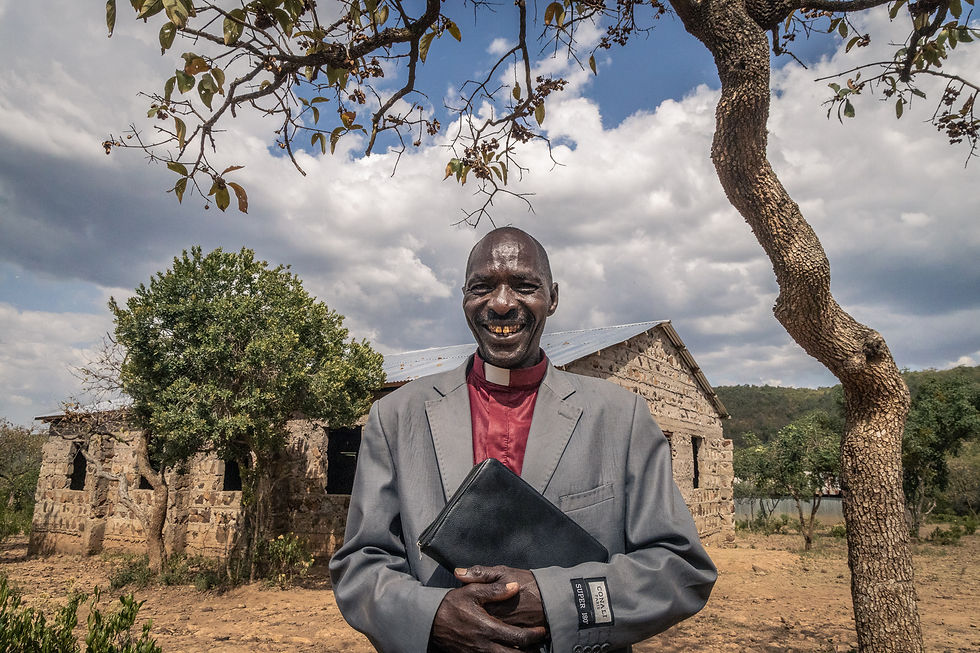
The Pokot pastor Joseph Parkilenya, in describing the peace process, chose to use a telling English word he had picked up when he said "Mimi ninaona hiyo ndio suluhisho tu. Ni ile wazungu wanasema: uache uwe flexible. Wewe unakuwa nyepesi kwa kila kitu. uwe nyepesi, be flexible. Hii maneno, we can win. (Personally, I see that this is the only solution. It's that thing that the wazungu say: leave it, be flexible. Be relaxed about everything. Be relaxed, be flexible.)"
Sveva Gallmann, co-director of the Conservancy, also acknowledged this gradual acceptance of the need for integration: "Of course underlying this is just the fact that we've gotta work together. We don't have a choice, you know. This is where we live and this landscape is such that we're never going to build fences and keep people out."
Or, in an idiom frequently voiced, this time by the assistant security manager of LNC, Kenneth Odhiambo: "Huwezi toa jirani. Huwezi choose jirani. (You can't remove your neighbor. You can't choose your neighbor.)"
This is the opportunity of those working on the "frontlines" of conservation: to recognize the fundamental dysfunction of the model we have been using and to rediscover what many of the communities we work alongside have not yet forgotten. What this requires on our part as conservationists is to bring "both feet to shore" and accept that we could never separate ourselves from nature or culture to begin with. It means lowering the drawbridge to the fortress and exposing ourselves to a reality that is inherently beyond our management. "We must not…seek self-consistent moral axioms that hold forever and settle all moral questions self-consistently," says Kauffman. "Rather, we must continue the conversations forever as our culture and its circumstances change." [28]
3. Moral Emergence
This is not an easy path. "The philosophy of reciprocity is beautiful in the abstract, but the practical is harder," Kimmerer admits later in her book. [29] When she speaks of the rhizomatic growth of the eponymous sweetgrass as an image for a more entangled ecological relationality, she acknowledges, "This was a good plan when the land was whole. But those tender white rhizomes cannot make their way across a highway or parking lot…The runners of the story could not find their way through a fragmented cultural landscape to me." [30] When speaking of fortress conservation, we must acknowledge that the land is indeed no longer whole. In this sense an effort to change approaches can seem futile. Even if we try to do things differently, aren't we making ourselves vulnerable? Can a "single" node of an emergent system withstand the avaricious tide of capitalist development? Doesn't our experiment end when you hit the next fenceline?
Nigel expressed this reservation well: "[If] during those periods when we come under intense pressure, that cooperative works, then I think it will be a complete blessing, and it will be completely new and innovative and progressive system that we will have created here, that might be possible to replicate in other places… but it does feel like an experiment to me right now, very much so, we've gone off on a very unusual path for a lot of conservationists…it definitely takes a lot more effort to do it this way."

It took moral courage, stamina, and self-reflection on the part of all participants in the peace process to look into this fearful mirror of accountability. Yet that proved to be the essential ingredient to the process. Somehow, in the mutual leaning into vulnerability and humility, perhaps allowing space for entrenched resentments to breathe or be seen, a new and stronger relationship emerged. This is a paradox that would confound our classical Western conception of nature, in which the "survival of the fittest" depends principally upon hierarchy and competition. Yet it is a paradox not unfamiliar to spiritual and wisdom traditions.
Throughout the Mshipi process, I had a copy of the Tao Te Ching, translated by Red Pine, that I would frequently sit with in the misty dawn before clambering into the Land Cruiser for another dusty day under a tree. I would read lines like these, in Verse 29: "Trying to govern the world with force / I see this not succeeding / The world is a spiritual thing / it can't be forced / to force it is to harm it / to control it is to lose it." [31] In the thick of the clouded uncertainty and the painstaking process, something about the lucid, confident statements of these paradoxes would invigorate me just enough to venture out yet again.
Similarly, many of my collaborators expressed that the critical posture was humility. Wayne Kamama, a young Pokot man who served as a translator throughout much of the Mshipi process, explained, "Sasa mi naamini kila kitu inawezikana. Inamaanisha hivi: kila mwanadamu, kwa level yake ya mafikira yake, hadhani kuna mwingine ako juu yake kwa mafikira. Kila mtu anafikiria ako the top ya mafikira ya wanadamu. Kama ni elder ya mpokot, kama ni elder ya mzungu. But the reality is, hakuna mtu ako top. (Personally I believe that everything is possible. It means this: every human, according to the level of their understanding, doesn't think that there's another person above them in understanding. Every person thinks they have the top understanding of all humans. Whether it's a Pokot elder, or an mzungu elder. But the reality is, no one is on top.)" Representing such an mzungu, Nigel agreed, "When you're coming into contact with that sort of stubbornness and then you start to see the stubbornness inside of you, what starts to arise with that kind of [self-]righteousness. It's very interesting to kind of hold that mirror up to yourself."
A key member of the peacebuilding team named Samuel Bokol expressed his own learning with a poignant and precise eye for the underlying dynamics of alienation and mutuality. "Both sides have something to hold on when it comes to the issue of justifying yourself, yes they did this to me, that's why this happened and this happened," he explained. "[But] if you keep quiet with your own pain and the other person keeps quiet with his own pain, it's like the fire is still burning. So if someone comes to a point of realizing now I have to reconcile with this person for my own benefit and also secondly his benefit…I have seen it now and I am convinced that it's the only way. Using love and using your tongue."

In all of these quotations, it becomes clear that the possibility of healing, and therefore any possibility of the emergence of something new, is in the acceptance of entanglement, of implication in the relationality itself. True reciprocity is only unlocked by mutual vulnerability. Here is where Sveva too invoked her sense of spirituality: "It's been a massive learning curve, in just trying to maintain a very strong boundary whilst at the same time being open and sensitive. [It] has been quite a spiritual practice to be honest, and this sense of you know, we've been smashed, let's try again. Some people would probably call it lunacy, to be honest with you…It's a lunacy of faith, believing so strongly that it can happen, it must happen, it will eventually happen, even if it's not in my lifetime."
Kauffman is a scientist, yet in his wrestling with the inherent unknowability of the complex systems we live in and our need to engage with them nonetheless, he, too, ultimately invokes a spiritual posture: "We live our lives forward into mystery, and do so with faith and courage, for that is the mandate of life itself." [32]
The theologian Catherine Keller speaks to this theory of emergence when she says, "Order gathers at the very edge of chaos, where turbulent iterations in absolute unpredictability create a ''phase transition'' into a complex—and relatively stable—self-organization." [33] For those of us that witnessed the transformation at Laikipia Nature Conservancy, this formulation seems strangely familiar. But the emergence wasn't only in a new system of cooperation, a more complex and diversified organism, but also in a new sense of responsibility towards one another, and the possibilities therein. In the words of another scientist unafraid to "openly encounter the questions," "emergent from our sense of compassion, in mortal conflict with our insistent sense that we should win, is our haunting sense that things should be fair." [34]
4. Mukutan

I believe that this "haunting sense" pervades the field of conservation. I see in the tense defensiveness of practitioners (including myself) and in the constant and subtle evolution of the language, however performative, a clumsy but earnest desire to find a way that works. The troubling contradictions are evident to no one more than on-the-ground managers, mediators, and researchers, but the possibilities of radical integrated interdependence are also the most real to them, because they are participants in those emergent relationships. Despite my own critiques, I cannot help but admire and defend against armchair polemicists the people on the "frontline" whom I have seen swallow their self-righteousness, or their bitterness, their pride, their fear, and venture into authentic relationship—undertaking a work of spiritual depth and rigor that few of those shouting from a safe distance could imagine.

Alongside my conviction that there is a moral urgency to reckoning with these contradictions, I also see a unique and poignant moral possibility: ecologists will tell us that "change in systems often comes from the edge. The edge, or ecotone—that place where one biological system meets another—is the most dynamic, most vulnerable, and often most diverse part of a system." [35] These spaces of radical interaction and exchange can reveal to us our differences and invite us into new, previously unimaginable, ways of relating. I believe that conservation, in Africa in particular, is ripe for reflection and reform, if only we would plant both feet and pay attention to what the land and our neighbors might have to teach us. In the words of the anonymous anthropologist, "We are not beholden to our research aims, funders, or academic visibility, we are beholden to the people we have asked to make themselves vulnerable to us." [36]
In the wake and continuance of this peace process, the management of Laikipia Nature Conservancy decided to rechristen the organisation to reflect a generational shift in approach and priorities. After consultation with community members and elders, they adopted the name "Mukutan Conservancy," using a Swahili word whose root means "to meet" or "to come together." That meeting at the gate and uncountable other convergences were the very marrow of the transformation. It is appropriate that the new name suggests that to do conservation at all is a living, relational process of constant conversation.
Mukutan's new approach has attracted attention around the country and newfound support from the county and national government, who were both confounded by and implicated in the persistent violence in the region. If the Mshipi model continues to foster a resilient and productive social and ecological landscape, it will warrant serious consideration as an alternative to the prevailing approaches in large-scale conservation in Africa. Conservationists must be prepared to ask difficult questions of their neighbors and of themselves. To practice conservation "with love" and "the tongue," in the words of Samuel Bokol, will require a newfound faith and a moral courage only found in solidarity.

References
[1] Swahili for white people or foreigners.
[2] Elizabeth E. Watson. 2010. "A 'Hardening of Lines': Landscape, Religion and Identity in Northern Kenya." Journal of Eastern African Studies 4 (2), 203.
[3] Byron Caminero-Santangelo. 2014. Different Shades of Green African Literature, Environmental Justice, and Political Ecology. 1st ed. Charlottesville: University of Virginia Press, 3.
[4] Caminero-Santangelo, Different Shades of Green, 14
[5] Anonymous. "The Ethics of Mediation in Conservation Spaces." The New Ethnographer (blog). April 25, 2018. https://thenewethnographer.com/the-new-ethnographer/2018/04/25/the-ethics-of-mediation-in-conservation-spaces.
[6] Caminero-Santangelo, Different Shades of Green, 1-16
[7] Robin Wall Kimmerer, Braiding Sweetgrass: Indigenous Wisdom, Scientific Knowledge, and the Teachings of Plants (Minneapolis: Milkweed Editions, 2013), 207.
[8] Édouard Glissant and Betsy Wing, Poetics of Relation (Ann Arbor: The University of Michigan Press, 1997), 12.
[9] Édouard Glissant and Celia Britton, Treatise on the Whole-World (Liverpool: Liverpool University Press, 2020), 33.
[10] Brian Burkhart, Indigenizing Philosophy Through the Land: A Trickster Methodology for Decolonizing Environmental Ethics and Indigenous Futures (Michigan State University Press, 2019), 115.
[11] Stuart A. Kauffman, Reinventing the Sacred: A New View of Science, Reason, and Religion (New York: Basic Books, 2008), xi.
[12] Catherine Keller, "Talking Dirty: Ground Is Not Foundation," in Ecospirit: Religions and Philosophies for the Earth, ed. Laurel Kearns and Catherine Keller (New York: Fordham University Press, 2007), 65.
[13] Vanessa Wijngaarden, "Maasai Perspectives on Modernity: Narratives of Evolution, Nature and Culture," Critical African Studies 13, no. 2 (2021): 197–215, 201.
[14] Wijngaarden, "Maasai Perspectives on Modernity," 203.
[15] Watson, "A 'Hardening of Lines,'" 203.
[16] Saverio Krätli, Valuing Variability: New Perspectives on Climate Resilient Drylands Development, ed. Helen de Jode (London: International Institute for Environment and Development, 2015), https://www.iied.org/sites/default/files/pdfs/migrate/10128IIED.pdf.
[17] Caminero-Santangelo, Different Shades of Green, 26.
[18] Kauffman, Reinventing the Sacred, xi.
[19] Kauffman, Reinventing the Sacred, 276.
[20] Kauffman, Reinventing the Sacred, 271-280.
[21] Krätli, Valuing Variability, 4.
[22] Ursula Goodenough, The Sacred Depths of Nature, 1st ed. (New York: Oxford University Press, 1998), 78.
[23] Kauffman, Reinventing the Sacred, x-xi.
[24] Kauffman, Reinventing the Sacred, 244.
[25] Burkhart, Indigenizing Philosophy through the Land, xix.
[26] Glissant, Poetics of Relation, 155.
[27] Krätli, Valuing Variability, 4.
[28] Kauffman, Reinventing the Sacred, 271.
[29] Kimmerer, Braiding Sweetgrass, 238.
[30] Kimmerer, Braiding Sweetgrass, 262-263.
[31] Laozi, Tao Te Ching, trans. and ed. Red Pine (Port Townsend, WA: Copper Canyon Press, 1996), 102.
[32] Kauffman, Reinventing the Sacred, xi.
[33] Keller, "Talking Dirty," 70.
[34] Goodenough, The Sacred Depths of Nature, 115
[35] Starhawk, Earth Path: Grounding Your Spirit in the Rhythms of Nature (New York: HarperOne, 2004), 24.
[36] Anonymous, "The Ethics of Mediation in Conservation Spaces."
Bibliography
Anonymous. "The Ethics of Mediation in Conservation Spaces." The New Ethnographer (blog). April 25, 2018. https://thenewethnographer.com/the-new-ethnographer/2018/04/25/the-ethics-of-mediation-in-conservation-spaces.
Caminero-Santangelo, Byron. Different Shades of Green: African Literature, Environmental Justice, and Political Ecology. 1st ed. Charlottesville: University of Virginia Press, 2014.
Glissant, Édouard, and Celia Britton. Treatise on the Whole-World. Liverpool: Liverpool University Press, 2020.
Glissant, Édouard, and Betsy Wing. Poetics of Relation. Ann Arbor: The University of Michigan Press, 1997.
Keller, Catherine, and Laurel Kearns. "Talking Dirty: Ground Is Not Foundation." In Ecospirit: Religions and Philosophies for the Earth, edited by Laurel Kearns and Catherine Keller, 63–78. New York: Fordham University Press, 2007.
Kauffman, Stuart A. Reinventing the Sacred: A New View of Science, Reason, and Religion. New York: Basic Books, 2008.
Kimmerer, Robin Wall. Braiding Sweetgrass: Indigenous Wisdom, Scientific Knowledge, and the Teachings of Plants. Minneapolis: Milkweed Editions, 2013.
Krätli, Saverio. Valuing Variability: New Perspectives on Climate Resilient Drylands Development. Edited by Helen de Jode. London: International Institute for Environment and Development, 2015. https://www.iied.org/sites/default/files/pdfs/migrate/10128IIED.pdf.
Laozi. Tao Te Ching. Translated and edited by Red Pine. Port Townsend, WA: Copper Canyon Press, 1996.
Starhawk. Earth Path: Grounding Your Spirit in the Rhythms of Nature. New York: HarperOne, 2004.
Watson, Elizabeth E. "A 'Hardening of Lines': Landscape, Religion and Identity in Northern Kenya." Journal of Eastern African Studies 4, no. 2 (2010): 201–20.


Comments